PERFUME BOTTLE BUYING GUIDE
How to Choose a Perfume Bottle for Your Fragrance Project
A practical B2B guide to capacity, shape, neck finish, glass quality, decoration and the commercial questions to confirm before selecting a perfume bottle.
Quick answer
Start with the target fill volume, order quantity and market position. Then shortlist an existing bottle with a verified neck finish and dimensions. Check compatible sprayers and caps before committing to decoration or a box. A visually attractive bottle is only a workable choice when the components, processing, packing and project quantity can be coordinated.
1. Define the project before comparing bottles
Perfume bottle selection becomes much faster when the supplier receives a clear commercial brief. Prepare the target market, capacity, estimated quantity, launch timing, price position and a few reference images. These details help separate bottles that merely look suitable from bottles that can realistically support the project.
Capacity and format
Confirm whether the line needs a standard spray bottle, portable format, discovery size or reed diffuser container.
Visual weight
Glass distribution, base thickness and proportion influence whether the package feels minimal, premium, classic or bold.
Quantity and timing
Stock availability, customization MOQ, sampling and production scheduling can change the best bottle choice.
2. Compare capacity, proportion and shipping impact
| Capacity | Typical consideration | Questions to confirm |
|---|---|---|
| 30 ml | Compact presentation, gifting, travel-led or smaller fill volume. | Does the smaller scale still deliver the intended shelf presence? |
| 50 ml | A balanced starting point for many fragrance projects. | How do bottle height, width and box size affect the complete set? |
| 100 ml | Stronger volume value and larger visual presence. | What are the effects on glass weight, carton size and freight volume? |
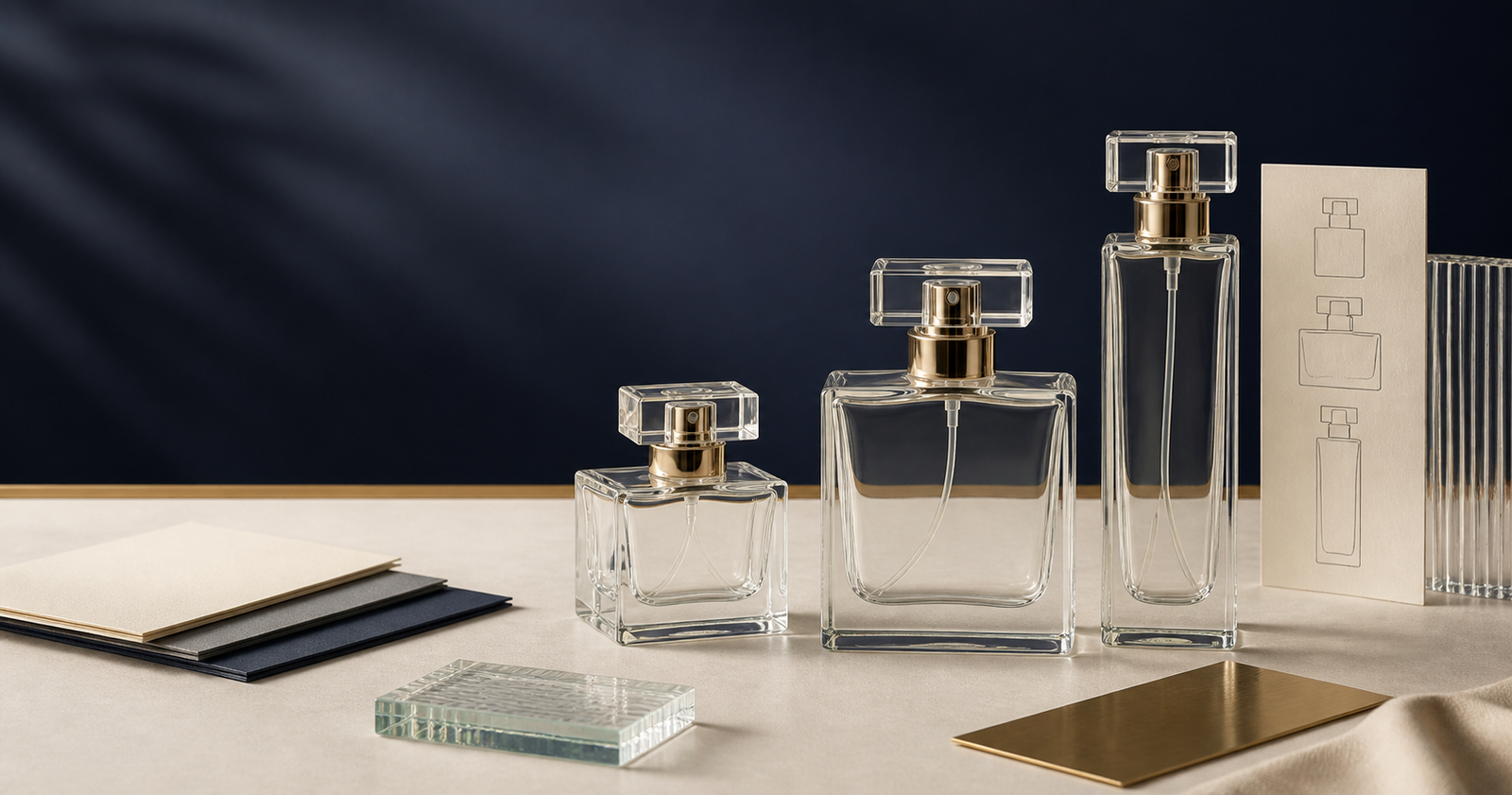
Capacity alone does not determine suitability. Two 50 ml bottles can have very different height, footprint, glass weight and decoration areas. Request technical dimensions before designing the box or finalizing artwork.
3. Treat the neck finish as a system decision
The bottle neck determines which sprayer and collar structures can be evaluated. The cap must then fit the selected assembly in both dimensions and removal feel. Do not purchase a cap or sprayer solely from a photograph.
- Confirm the neck finish and key dimensions.
- Match the correct crimp or screw sprayer specification.
- Check collar diameter, height and visible metal color.
- Test cap fit, clearance, alignment and removal force.
- Evaluate leakage and spray performance with representative samples.
Read the component compatibility guide →
4. Evaluate glass and manufacturing details
Ask for clear photos and physical samples to assess glass clarity, mold lines, base distribution, surface flatness and dimensional consistency. Acceptable tolerance depends on the bottle structure and manufacturing process. A supplier should explain what can be controlled and what must be treated as normal production variation.
Useful checks during sampling
- Overall proportions and actual filled appearance
- Glass color and clarity under neutral lighting
- Stability on a flat surface
- Decoration area and artwork alignment
- Fit with sprayer, collar, cap and box insert
5. Choose decoration after the bottle is confirmed
Coating, frosting, screen printing and hot stamping can change how a bottle is perceived, but each process has its own artwork, quantity and surface requirements. Confirm the bottle first, prepare vector artwork and color references, and approve a physical sample before bulk production.
Common selection mistakes
Designing the box too early
Final bottle and component dimensions should be confirmed before the insert and carton structure are locked.
Comparing only unit price
Decoration, component compatibility, packing, breakage protection and freight volume affect total project cost.
Skipping physical samples
Images cannot fully confirm weight, fit, color, spray feel or the complete package presentation.
Information to send for a bottle quotation
- Target capacity and quantity
- Reference bottle or preferred shape
- Target market and positioning
- Sprayer, collar and cap requirements
- Decoration and logo direction
- Box requirements, destination and expected timing
Use the complete quotation preparation checklist →
Frequently asked questions
Should a first-time fragrance brand choose a custom mold?
Not necessarily. A mature existing bottle can reduce development complexity and make component matching, sampling and initial inventory easier. A custom mold is better evaluated when the project has a clear volume plan and a design that cannot be achieved through decoration.
Can the same bottle use different caps?
Often yes, provided each cap is engineered for the selected sprayer and collar assembly. Compatibility must be checked with actual dimensions and samples.
When should the packaging box be designed?
Begin the visual direction early, but finalize structural dimensions only after the bottle, sprayer, collar and cap have been confirmed.
Shortlist the right bottle for your project
Send your capacity, quantity, target market and reference direction. ORVAELIS can help identify the next compatibility, customization and packing questions to confirm.